




The short answer
Comparing rental property investments in Athens and Thessaloniki therefore starts with a common brief: how much capital is available, what kind of apartment it should buy, who might rent it and how it will be managed. City data provide context. The decision depends on the property, its costs and your circumstances.
Updated 9 November 2026
1. Read the 2026 figures on their own terms
The Bank of Greece provides a consistent starting point for price trends:
| Bank of Greece geographic series | Apartment-price change, Q2 2026 versus Q2 2025 |
|---|---|
| Athens | +5.0% |
| Thessaloniki | +4.7% |
These are provisional nominal changes, based on bank valuations and reported property characteristics. They are neither asking prices nor an exhaustive record of completed sales. Neither percentage is a rental yield. Bank of Greece, release of 15 September 2026.
For asking-price levels, the Spitogatos Property Index (SPI) allows a separate comparison for Q3 2026:
| SPI area | Sale asking price, €/m² | Monthly asking rent, €/m² |
|---|---|---|
| Athens – Center: Municipality of Athens | €2,553 | €12.22 |
| Thessaloniki – Municipality | €2,740 | €10.94 |
Sale figures are rounded to the nearest euro. These are residential listing statistics, covering a mixture of property types and conditions. The comparison uses municipal areas, rather than central Athens against the wider Thessaloniki region. “Athens – Center” is the source’s label for the Municipality of Athens; the Thessaloniki row also covers the municipality, not just its central neighbourhood. SPI and methodology, public data feeding the SPI table, Spitogatos’ Q3 explanation.
This snapshot challenges the assumption that Thessaloniki is always cheaper. It does not establish that Athens offers the better investment: municipal boundaries and housing stock still differ, and neither row describes a matched apartment. Sale and rental listings are also separate samples. Dividing these aggregates would not verify the yield of a property someone can actually buy and let.
Keep the two sources separate. A Q2 bank-valuation index and Q3 asking-price levels answer different questions; they do not form a single price series.
2. Make two comparisons: the same property brief and the same capital
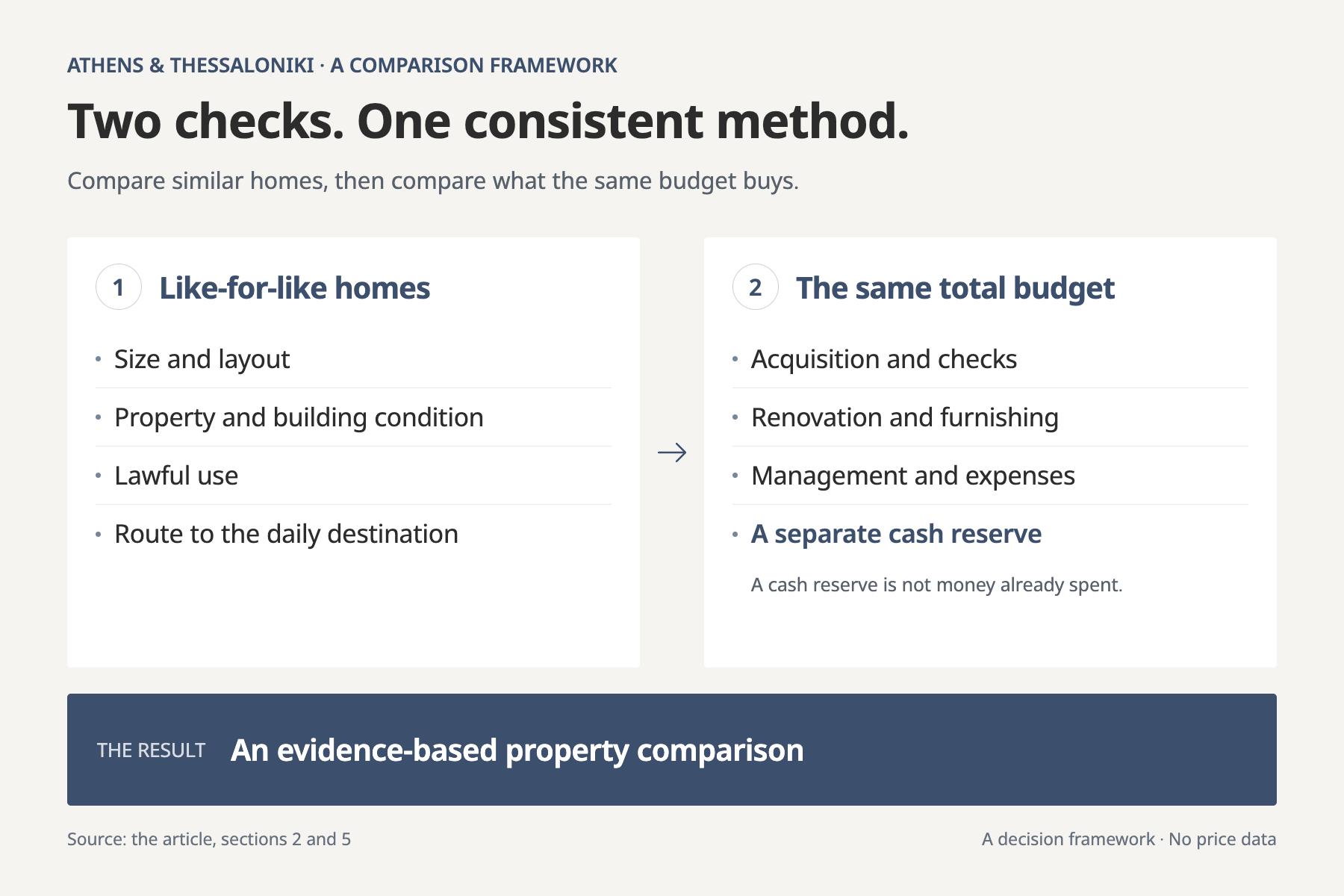
First, define the apartment you want to own. An illustrative brief might be a 45 m² apartment with a separate bedroom, lawful residential use, adequate daylight, usable heating and cooling, and a practical journey to the intended tenant’s daily destination. This is a search example, not a property offer or a claim about availability in either city.
Search both cities against that brief, recording differences without silently relaxing requirements. This shows what a comparable property costs.
Then reverse the exercise. Set the same total capital limit for each city and see what it buys. Include acquisition costs, professional checks, necessary works, furniture and preparation for letting. Identify a separate cash reserve for interruptions and unexpected repairs; do not treat it as money already spent.
This second comparison may produce different apartments. That is useful, provided the trade-off is explicit: a lower purchase price might require more work, while a higher price might leave less cash available after completion. Neither outcome follows automatically from the city’s name.
For a financed purchase, establish available borrowing and actual debt payments for each property. The purchase price alone says little about the owner’s cash commitment.
3. Compare similar apartments
Make the differences between candidates explicit. A furnished studio and an unfurnished one-bedroom apartment serve different needs. Equal advertised floor areas are not enough either: check what each figure includes, the floor, lift access, condition and any work required in the building.
Take one candidate from each city and review the legal and technical findings in the same detail. Add required works and the apartment’s share of expected common building costs to each price. This helps show whether a price gap reflects location or additional investment needed in one of the properties.
4. Compare the tenant’s daily life
Student housing is relevant in both cities, but “near a university” needs a specific destination. Aristotle University’s main campus is in central Thessaloniki, with some facilities elsewhere. In Athens, the National and Kapodistrian University’s Department of Educational Studies, for example, is on the Zografou campus. Those locations create different search areas; neither university’s existence proves demand for a particular flat. Aristotle University, University of Athens: facilities and access.
Athens offers several urban rail lines to investigate when choosing a commuting location. That gives the search multiple possible corridors, but makes the precise route and interchange requirements important. In Thessaloniki, assess metro access together with connecting buses; OSETH’s August 2026 network changes around Kalamaria illustrate why an old transport description can become unreliable. STASY route information, OSETH network announcement, 27 August 2026.
Define the same need in both cities—for example, accommodation for one person travelling to a particular campus—and compare each apartment against it. A lower-priced apartment with an awkward commute may not be an equivalent option for the tenant.
5. Put ownership costs and management beside the rent
Compare annual income after a realistic vacancy allowance and owner-paid operating costs. Include the management agreement, maintenance, insurance, the owner’s common building charges and ENFIA, Greece’s unified property tax. Obtain the property’s tax information rather than copying another apartment’s bill. AADE: E9 and ENFIA.
Obtain management quotes for the same scope of service and charging basis. If you live in one city, compare the time and travel involved in owning a property in the other. That personal difference may matter more than a small gap in rent.
Test a less favourable year with a longer vacancy, a lower achievable rent and a repair. If either option requires immediate rent increases or an assumed resale gain to remain affordable, reconsider the price or capital commitment.
Keep personal income tax and financing separate from the operating comparison. Tax residence, ownership structure and applicable treaty rules require an individual assessment. Where capital or spending is in another currency, exchange-rate exposure also matters.
If short-term rental is proposed as a fallback, verify the current rules for the exact address and use before attaching income to that option. A long-term rental comparison should stand on its own assumptions.
6. Which differences could decide the choice?
The data and checks above lead to three distinct considerations:
- Price and budget: in the Q3 2026 SPI snapshot, the Municipality of Athens has a lower sale asking price per square metre and a higher asking rent than the Municipality of Thessaloniki. Do not assume Thessaloniki is always cheaper. Check a shortlist of comparable apartments to see whether that pattern holds for the property type you want.
- Where to search: Athens’ rail network offers several routes and residential areas to consider. In Thessaloniki, a search can be focused around a named destination, such as the main university campus, or along metro and bus connections. In either city, a practical daily journey matters more than a “central” label.
- Your ability to manage the property: familiarity with a city, living nearby and reliable local support can reduce the work you need to organise. If you are starting without contacts in either city, assess the professionals and management arrangements in the same way in both.
Each consideration can change the shortlist. None replaces an individual property assessment or establishes a citywide return.
7. Choose the property you can justify
Build a small shortlist in each city and compare documented costs, credible rental evidence, the building’s condition and a workable management arrangement. Then consider the eventual buyer: could the apartment serve an owner-occupier as well as a landlord, and would its layout or documentation restrict that audience? A rising index cannot answer how quickly a particular property will sell.
The stronger option is the one that fits your capital, holding period and ability to manage uncertainty. Sometimes that will be Athens, sometimes Thessaloniki; sometimes the sensible outcome is to keep looking.
If Thessaloniki remains on your shortlist, explore Wiser’s investor guide or discuss a specific property’s suitability, inclusions and management terms with the team.
General information, not a personal investment recommendation. Legal, technical and tax conclusions require checks for the property and owner concerned.
Frequently asked questions
Is it useful to compare equally priced flats if one is a studio and the other has a separate bedroom?
They can be compared as alternatives, but the same asking price does not make them equivalent. For a like-for-like comparison between Athens and Thessaloniki, use the same layout, standard of finish, building condition and intended use. If your shortlist includes a studio in one city and a one-bedroom flat in the other, record that trade-off and assess each against the intended tenant’s needs. Compare their full costs too, since equal asking prices can hide different renovation and furnishing needs.
What if my budget buys a suitable flat in only one of the two cities?
Keep that flat on the shortlist only if it meets your brief within the total capital available. Include acquisition and professional costs, necessary renovation and furnishing, while identifying a separate cash reserve. If an equivalent property in the other city is unaffordable, either revise the brief openly for both cities or continue assessing the candidate that fits. Do not bridge the gap by assuming immediate rent increases or that essential work can be ignored.
How can I tell whether a city’s apparent price advantage applies in my chosen neighbourhood?
Check whether the claimed advantage appears in recent listings for comparable flats in the neighbourhoods you would actually consider. Use the same period and compare size, layout, floor, lift access, condition and furnishings, noting any differences. Assess sale and rental listings separately: asking figures do not establish completed sale prices or agreed rents. If there are few close matches, treat the city-level comparison as context rather than evidence that one candidate offers better value.
Is a central Thessaloniki flat equivalent to one near the metro in Athens?
Those labels alone do not make the properties equivalent. Define the same practical need in both cities, such as reaching a particular workplace or campus, then compare each relevant door-to-door journey at the times it would actually be made. Include walking, waiting and transfers, and check current official route information and service notices. A central address or nearby station is useful only if the whole journey works for the intended tenant.
Can familiarity with one city justify choosing it even if the expected rent is lower?
Yes, if that familiarity translates into practical savings or a workable management arrangement. Compare the owner-paid costs, time and travel needed for each property, using written quotes for the same scope of local support. Distinguish contacts who can provide a defined service from friends who may occasionally help. Lower expected rent may be an acceptable trade-off, but knowing a city does not compensate for an unsuitable flat, unresolved building problems or an unaffordable purchase.


