



The short answer
For a long-term rental, assess the whole routine: travelling to work or study, buying groceries, returning home at night and having an alternative when the usual route is unavailable. This guide connects the metro network, including the Kalamaria extension, to the practical checks that matter for an individual apartment.
Updated 9 November 2026
1. Start with the network in service
The Kalamaria extension opened on 27 August 2026. The operator’s announcement confirms its inauguration, while Elliniko Metro’s passenger-service notice identifies the five additional stations: Nomarchia, Kalamaria, Aretsou, Nea Krini and Mikra. Inauguration announcement, passenger-service announcement.
At the research date, operator THEMA lists 18 stations: 13 on the base network and five on the extension. The terminals include New Railway Station, Nea Elvetia and Mikra. Record the starting station and the train destination needed for a journey, rather than treating “metro access” as a complete description. THEMA’s stations and passenger information.
Read map legends carefully. Elliniko Metro’s August 2024 development map includes the base project, Kalamaria and further extensions. It explains the plan but is not, by itself, a current service map. THEMA also presents long-term expansion separately. Assess a purchase using today’s access; consider future improvements as a separate scenario without assigning an unverified opening date. Official development map, future extensions.
The airport connection involves a bus. OSETH, Thessaloniki’s transport authority, announced the X3 service between Mikra metro station and Makedonia Airport. This is a metro-and-bus journey, not a direct train to the terminal. Include the walk to the bus stop, waiting and road travel in the assessment. OSETH’s announcement of 27 August 2026.
2. Measure the walk to an entrance
Start with the building’s address and the exact station entrance. A straight-line distance can conceal a road crossing, barrier, steps or an entrance on the opposite side of the street. Select a walking route on a public street map, save its distance and estimated time, then test it during a visit. An app’s estimate is a starting point, not a site measurement.
There is no single acceptable walking time for every apartment or resident. Set a limit appropriate to the use you are assessing and apply the same method to each property. A slightly longer route may be more practical if it has continuous pavements, good lighting and straightforward crossings. Consider carrying shopping, pushing a pram or pulling a suitcase, as well as conditions in hot or wet weather.
Accessibility needs to work continuously, from the apartment door through the building and street to the platform and destination. A station lift cannot resolve steps at the apartment building. THEMA publishes a lift-status page: consult it before a visit and, where lift access is essential, assess an alternative for an outage. Station lift status.
Return in the evening to assess lighting, visibility at crossings, vehicle movements and noise outside the building. These are checks on the actual route and property; a station symbol cannot establish comfortable conditions along the entire walk.
3. Compare complete journeys to everyday destinations
Choose specific destinations: a workplace address, the relevant teaching building, a grocery shop and a healthcare service. Give a journey made every day more weight than an occasional trip. Airport access may be useful, but it cannot substitute for checking the places residents use routinely.
For each destination, add the time to reach the station entrance, descend to the platform, wait for the appropriate train, travel, make any connections, exit and finish the walk. Check the return journey too, particularly when it falls late in the evening or relies on a less convenient connecting service.
Illustrative example: two fictional apartments are compared for a journey to the same destination. The times are assumptions in minutes, with no change of train; they are not measurements of particular routes or stations.
| Journey component | Apartment A | Apartment B |
|---|---|---|
| Apartment door to station entrance, including leaving the building | 7 | 11 |
| Entrance to platform | 3 | 3 |
| Waiting for the appropriate train | 4 | 4 |
| Train journey | 12 | 6 |
| Arrival platform to destination door | 6 | 4 |
| Total | 32 minutes | 28 minutes |

The walk from Apartment B to the station is longer, but the whole journey is 4 minutes shorter. For real apartments, compare routes at the same times of day and record how much journey times vary.
At the research date, THEMA publishes operating hours of 05:15–00:30 Sunday–Thursday and 05:15–02:00 Friday–Saturday. These are first and last departures from the terminals, not passing times at every station. Check service notices and the times relevant to the actual journey. THEMA operating hours.
4. Turn a station name into a property question
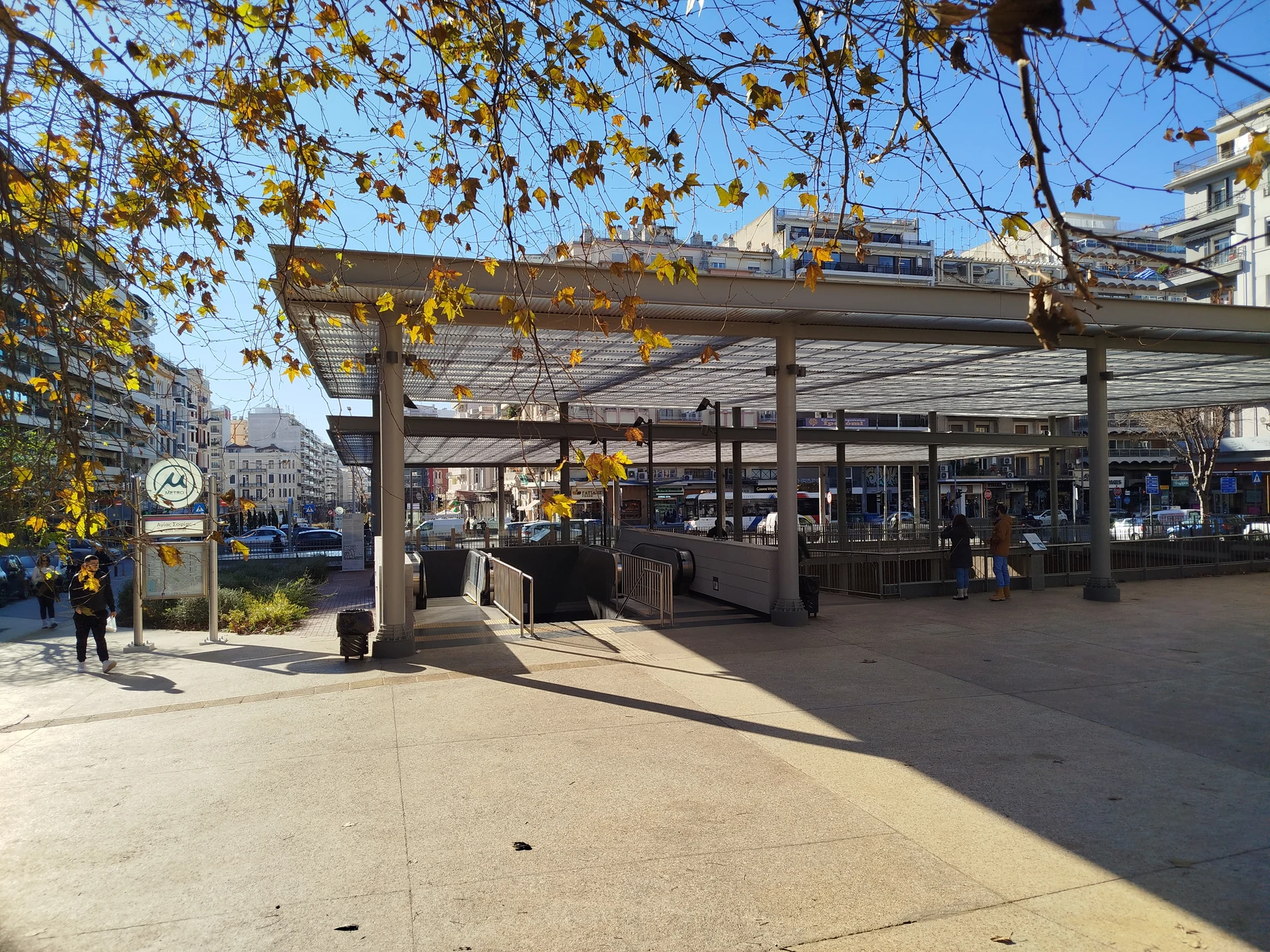
Recognisable stations can help organise a search, but the assessment must finish at a specific address. These examples use stations on the operator’s list. They are prompts for investigation, not neighbourhood rankings or purchase recommendations. THEMA station list.
| Example stations | What to test for an apartment being considered nearby |
|---|---|
| Venizelou / Agias Sofias | Is the onward walk convenient for the workplace or service required? Does street activity reach the apartment, and how do street-facing and courtyard-facing rooms differ? |
| Sintrivani / Panepistimio | For a study destination, which building and gate are relevant? How much walking remains after leaving the station? |
| Kalamaria / Aretsou / Nea Krini | Which entrance does the route from the building reach? Does the daily routine also require a bus? The area’s name alone does not establish accessibility. |
| Mikra | For airport access, what is the complete journey with X3? For another destination, does this station actually serve the required trip? |
Connecting buses need current checks too. In October 2026, for example, OSETH announced temporary route changes in Kalamaria because of roadworks, including changes to the stops served during the diversions. This illustrates why current notices matter; it does not mean a particular temporary arrangement continues unchanged. OSETH’s notice of 14 October 2026.
Compare walking directly or taking a direct bus as well. For a particular apartment and destination, a journey without changes may be more suitable than a metro connection.
5. Ask how much of the benefit is already in the price
Convenient transport is a property characteristic. The amount worth paying for it requires a separate comparison. The transport sources above verify services and plans; they are not research isolating the metro’s effect on apartment prices. They do not establish a rate of appreciation or an expected rental premium.
Compare apartments with similar floor area, floor level, condition, lift access, daylight, noise and furnishing. Then examine the differences in access and price. If the apartment nearer a station is also better renovated, the entire price difference cannot be attributed to the metro. If an asking price already reflects expectations of improvement, do not count those expectations again in the investment case.
If the premium is supported only by nearby asking prices, check that the purchase still works without assuming extra rent because of the metro.
Convenience can involve trade-offs. At the nearer apartment, investigate street noise, commercial activity and privacy. At the more distant one, establish whether the additional walk is acceptable. The aim is a workable combination of purchase price, apartment quality and daily life.
6. Keep a property-specific record
Before giving an apartment an advantage because of the metro, assemble a short record that can be revisited:
- Address and entrance: a saved walking route, distance, estimated time and date checked.
- Site observations: time measured from the apartment door, crossings, steps, lifts, lighting and an evening visit.
- Named destinations: complete journeys to work or study and everyday services, including the return.
- Service dependencies: train destination, connections, required hours and an alternative during disruption.
- Living conditions: noise inside the apartment, privacy and building access, alongside physical and legal property checks.
- Price evidence: comparable apartments, with asking prices distinguished from available transaction or tenancy evidence.
Start with essential requirements, such as an accessible route or the ability to reach work on time. Compare convenience and price after those requirements are met. Proximity to a station should not obscure a material problem with the apartment or building.
A long-term rental needs to function within a real daily routine. The metro can be a significant part of that routine; establish its value through a checked journey and property evidence you can explain. For the wider assessment of an apartment and its costs, explore Wiser’s investor guide or speak with the team about the suitability of an apartment in a Wiser project.
Frequently asked questions
How can I check the walk to the station advertised in a listing?
Measure it from the apartment door to the station entrance you would actually use. Establish which entrance the listing refers to, then walk the route, including the building exit, crossings and any steps. Record the time and walking conditions during your visit, since an app estimate cannot show everything you encounter on the street. Time the journey from the station entrance to the platform separately.
How can I assess transport access before knowing who will rent the apartment?
Test several plausible everyday destinations without assuming that every tenant will have the same routine. Choose relevant workplace addresses or teaching buildings, alongside shopping and healthcare, and compare every apartment against the same destinations. Check outward and return journeys at times appropriate to each destination. This shows which journeys the location could support; it does not establish demand for the apartment or a particular rent.
How should I compare an apartment near the metro with one served by a direct bus?
Compare the complete journey time and convenience at the hours the service will be needed. A direct bus may work better if it avoids a difficult walk or a change, but account for waiting, variation caused by traffic and the return service. Test both options on more than one day and consider an alternative during disruption. Proximity to the metro alone should not decide between the apartments.
Does a station lift mean I can rely on a completely step-free journey?
No. Check the entire route from the apartment door to the destination, including the building, pavements, station entrances and the exit at the other end. Identify the lifts needed at both ends and consult THEMA’s lift-status page shortly before travelling. If the route depends on a lift, check whether there is an alternative that the person making the journey could use when it is unavailable.
Does the metro run directly to Thessaloniki Airport?
No. The connection from Mikra metro station to Makedonia Airport uses the X3 bus, so passengers change from metro to bus. Include the walk to the stop, waiting and road travel, and check both services against the required airport arrival time and the return journey. When comparing apartments, weigh airport access according to how often it is likely to be used, alongside the everyday journeys the location needs to support.


