




The short answer
To assess a Thessaloniki rental investment, follow the money through acquisition, letting, operating expenses and financing. The worked example below connects those stages and shows what changes in a weaker year.
Updated 9 November 2026
Illustrative example — assumptions for calculation, not a Wiser transaction, forecast or offer. Prices, rents, fees, occupancy and financing terms are illustrative, not market benchmarks. The transfer-tax rule is sourced separately. All service-cost assumptions include applicable VAT; the management percentage is also an assumed final charge. The model covers 12 months of ownership, including preparation and initial letting within the assumed vacancy period. It ends before personal income tax.
1. Establish the full acquisition and setup cost
Start with the agreed price and an explicit list of what it includes. In this example, renovation and furniture are additional costs.
| Acquisition and setup — illustrative amounts | Cost |
|---|---|
| Apartment price | €100,000 |
| Transfer tax, including municipal levy | €3,090 |
| Notary, including documents and copies | €1,200 |
| Property registration | €700 |
| Buyer’s legal work | €1,000 |
| Engineer’s checks | €600 |
| Brokerage or purchase support | €1,200 |
| Other documents, translation, representation and transfer costs | €210 |
| Renovation | €8,000 |
| Furniture, equipment and preparation for letting | €4,000 |
| Total acquisition and setup cost | €120,000 |
For the ordinary transfer-tax regime, AADE, Greece’s tax authority, specifies 3% of taxable value, plus a municipal levy equal to 3% of that tax: effectively 3.09%. Here, the assumed taxable value is €100,000, with no exemption and no property VAT charged instead. Thus €3,000 + €90 = €3,090. Taxable value is a separate input; do not automatically copy an asking price into it. Confirm the applicable regime and value with the notary for the transaction date. AADE — Real Estate Transfer Tax.
The other amounts are budgeting assumptions, not statutory tariffs or Wiser fees. For a real purchase, replace them with written quotes. If renovation or furniture is already included in the price, remove the corresponding additional charge. The purchase preparation guide explains the wider checks behind those costs.
2. Move from contractual rent to collected income
The base case assumes €600 monthly rent and one month without rent, including preparation and finding the first tenant. The other 11 months are paid in full within the period. Potential rent is €7,200; collected rent is €6,600.
That last distinction matters. A signed lease and a bank receipt are different things. If you start with actual receipts, vacancy is already reflected in them: do not deduct it again. Record unpaid rent separately, and keep a refundable tenant deposit outside rental income.
| Owner-paid operating expenses — base case assumptions | Annual cost |
|---|---|
| Management: 8% of €6,600 collected | €528 |
| Routine maintenance and minor repairs paid during the year | €360 |
| Property insurance | €180 |
| ENFIA property tax | €240 |
| Owner’s common building charges and utilities during vacancy | €240 |
| Accounting and administration | €180 |
| Finding the first tenant | €300 |
| Bank charges | €24 |
| Total operating expenses | €2,052 |
The management assumption has no minimum or separate vacancy charge; the €300 letting charge is separate. Actual contracts may work differently. The €360 repair amount represents spending in this scenario, not money placed in reserve. Ordinary tenant-paid bills are outside both income and expenses.
ENFIA is Greece’s annual property ownership tax, linked to rights held on 1 January. Its assessment depends on property and ownership characteristics; €240 is an assumption, not a standard bill for a €100,000 apartment. Greek Finance Ministry — ENFIA.
3. Understand what each yield measures
Net operating income = collected rent − owner-paid operating expenses.
Here, €6,600 − €2,052 = €4,548. This definition includes the listed property tax, letting and administration costs. It excludes financing, personal income tax and the acquisition and setup costs already recorded upfront.
| Measure | Calculation | Result |
|---|---|---|
| Potential gross rental yield on purchase price | €7,200 ÷ €100,000 | 7.20% |
| Net operating yield on total acquisition and setup cost | €4,548 ÷ €120,000 | 3.79% |
The difference reflects both the costs and vacancy deducted from rent, and the larger total investment used in the calculation. Neither number includes a change in the apartment’s value. An eventual capital gain is a separate outcome, not cash available to pay this year’s bills.
Use the same definitions when comparing properties. A percentage without its cost base and expense list is an incomplete comparison.
4. Run the same property through a weaker year
Keep the acquisition cost unchanged. Now assume rent is 5% lower at €570, two months produce no rent, and an additional €1,000 repair is paid. The vacancy period again includes preparation and letting. There are no other arrears or capital works in this scenario.
Management falls with collected rent. Other base operating costs remain €1,524; the additional repair sits on top of the original €360 maintenance spending.
| Annual result | Base case | Weaker case |
|---|---|---|
| Monthly rent | €600 | €570 |
| Months of rent collected | 11 | 10 |
| Collected rent | €6,600 | €5,700 |
| Management at 8% | €528 | €456 |
| Other base operating costs | €1,524 | €1,524 |
| Additional repair | €0 | €1,000 |
| Total operating expenses | €2,052 | €2,980 |
| Net operating income | €4,548 | €2,720 |
| Operating yield on €120,000 | 3.79% | 2.27% |
This is a sensitivity test, not a worst-case boundary. A longer payment dispute, substantial building works or a renovation overrun could cost more. The useful question is whether the lower income still fits your budget and alternatives.
5. Add financing to see the cash flow
Assume a €50,000 loan drawn at acquisition, a fixed nominal annual interest rate of 5%, and full repayment over 20 years through 240 monthly instalments, starting one month after drawdown. There is no repayment holiday or balloon payment. These are calculation assumptions, not a loan offer or a statement about eligibility.
For equal monthly payments, the formula is:
Payment = loan × r ÷ [1 − (1 + r)⁻ⁿ], where r = 5% ÷ 12 and n = 240.
The result rounds to €329.98 a month. This model uses 12 payments at that rounded amount: €3,959.76 a year. Loan-related setup costs are a separate assumed €1,000, covering arrangement, valuation and security-registration costs, with no further recurring loan charges in this example.
Cash flow after debt service = net operating income − interest and principal payments.
| Before personal income tax | Base case | Weaker case |
|---|---|---|
| Net operating income | €4,548 | €2,720 |
| Annual loan payments | −€3,959.76 | −€3,959.76 |
| Cash flow after debt service | €588.24 | −€1,239.76 |
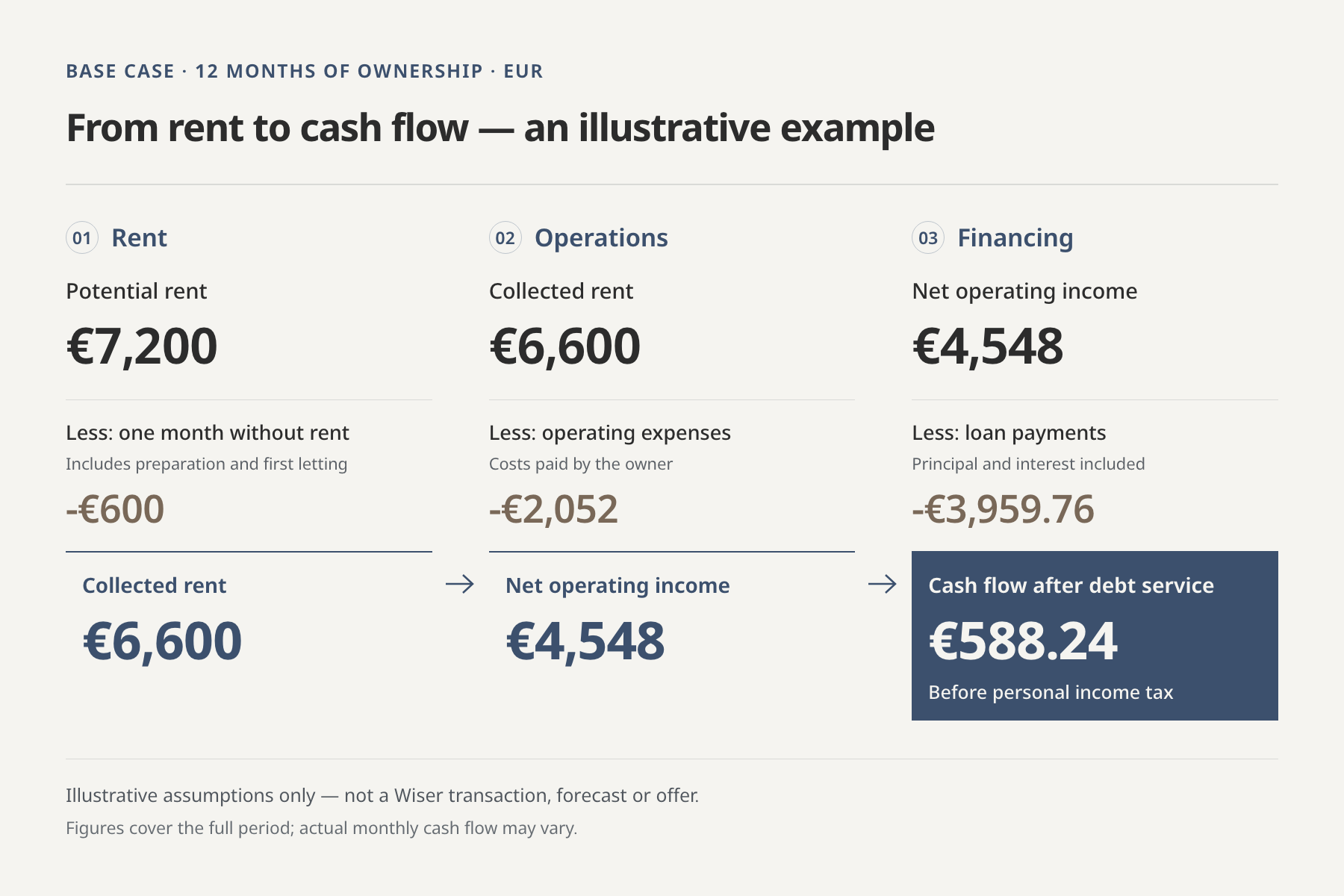
The base case averages just €49.02 a month before personal tax. Actual monthly cash flow will be uneven. In the weaker case, the owner must fund a shortfall despite positive operating income.
Principal repayment reduces the loan balance but still uses cash. It is not deducted in the operating-income calculation, and this model does not treat it as a tax-deductible expense. Borrowing reduces the equity required at acquisition while introducing payments that continue during vacancy.
6. Keep the reserve visible and count it once
Assume the owner also allocates €3,000 as a cash reserve. Without borrowing, the initial allocation is €120,000 + €3,000 = €123,000. With the illustrative loan, it is €120,000 − €50,000 + €1,000 financing costs + €3,000 reserve = €74,000.
The reserve remains the owner’s money. It is not an annual operating expense, so it is not subtracted again from €4,548. If a repair is paid from it, count the repair once and update the reserve balance. A later transfer to replenish the reserve reduces cash available for withdrawal, not operating income a second time.
For an all-cash investor, dividing €4,548 by the full €123,000 allocation gives 3.70%. That uses a different denominator from the 3.79% property measure. The assumed €3,000 reserve is not evidence of adequacy: test payment timing, tax bills and larger repairs separately.
7. Account for your tax position before deciding
The calculations stop before personal income tax. Operating cash flow is not automatically taxable income: Greek tax rules determine which deductions apply. Do not apply a tax rate directly to €4,548 or €588.24 and assume the result is correct. Greek Finance Ministry — Income Taxation.
Tax residence and ownership structure matter. AADE identifies income from Greek property as Greek-source income and explains that relevant tax treaties apply to non-residents. Residence-country reporting and treaty treatment require the owner’s specific circumstances. AADE — Greek-source income and non-residents.
The model is in euros. If your spending or borrowing uses another currency, assess conversion costs and exchange-rate exposure separately. A future sale also requires its own calculation of proceeds, selling costs, tax and outstanding debt.
For a specific property, replace each assumption with evidence: agreed inclusions, comparable rents, written service quotes, building expenses and financing terms. Then check whether both the base case and a weaker year fit the cash you can commit. You can continue with Wiser’s investor guide or discuss a particular Wiser property’s price, specification and management terms with the team.
Frequently asked questions
How do I compare two offers when only one includes renovation and furniture?
Compare the total cost of getting each apartment ready to let to a similar specification. Add applicable taxes, professional fees, registration and only the work and equipment not already included in the agreed price. Check that quotes include applicable VAT, and account for differences in preparation time and rent that may be delayed. A lower price before the work does not establish a lower overall cost.
Does setting aside a repair reserve reduce my rental yield?
An unspent reserve is not an operating expense, so it is not deducted from net operating income. Show it separately within the capital allocated and state whether that capital is included in the denominator of your yield calculation. When a repair is paid from the reserve, record the expense once. Replenishing the reserve reduces cash available to withdraw but does not create another operating expense.
If I have calculated rent for 11 months, should I also deduct a vacant month?
No, if the vacant month is already reflected in those 11 months, another deduction would count the same lost rent twice. In the article’s illustrative example, €600 a month multiplied by 11 gives €6,600, assuming it is all collected within the period. Deduct owner-paid expenses from those receipts, recognising that some costs may continue during vacancy. Include time spent on renovation or finding a tenant only once within the period without receipts.
Why might I need to add cash when the property has positive operating income?
Loan repayments can exceed the operating income left after property expenses. In the article’s illustrative weaker scenario, €2,720 of net operating income less €3,959.76 in loan payments produces an annual shortfall of €1,239.76, before personal income tax. Those payments include principal and interest, and reducing the debt does not provide cash to pay bills. These figures are calculation assumptions, not the performance of a Wiser property.
What should I change in the base case to test whether the investment fits my budget?
Test lower rent, longer periods without receipts and an extra repair, first separately and then together. This shows which assumptions matter most and how added costs interact with reduced income. Also map loan payments and larger bills by month, checking whether available cash covers any shortfall without relying on a rise in property value. The article’s weaker scenario is a sensitivity test, not a limit on possible losses.


