




The short answer
The data reviewed for this article show continuing price increases, with more moderate annual growth in advertised sale prices and rents than a year earlier. That supports a measured approach to the Thessaloniki property market: investigate the rental case, compare the alternatives and avoid paying today for appreciation that may never arrive.
Updated 9 November 2026
For anyone considering a purchase in 2027, these are the figures available to work with now. They cover specific quarters of 2026, rather than the full year, and do not forecast next year’s market.
1. The market snapshot: three figures, two different measures
The Bank of Greece release used here was published on 15 September 2026 and covers the second quarter. Spitogatos’ report was published on 2 November and covers the third quarter. Keep those dates alongside the numbers.
| Indicator for Thessaloniki, as defined by each source | Reference period | Year-on-year change |
|---|---|---|
| Bank of Greece apartment price index, based on bank valuations; provisional | Q2 2026 compared with Q2 2025 | +4.7% |
| Spitogatos average residential sale asking prices | Q3 2026 compared with Q3 2025 | +6.7% |
| Spitogatos average residential rental asking prices | Q3 2026 compared with Q3 2025 | +5.3% |
Sources: Bank of Greece, Q2 2026 release; Spitogatos, Q3 2026 report.
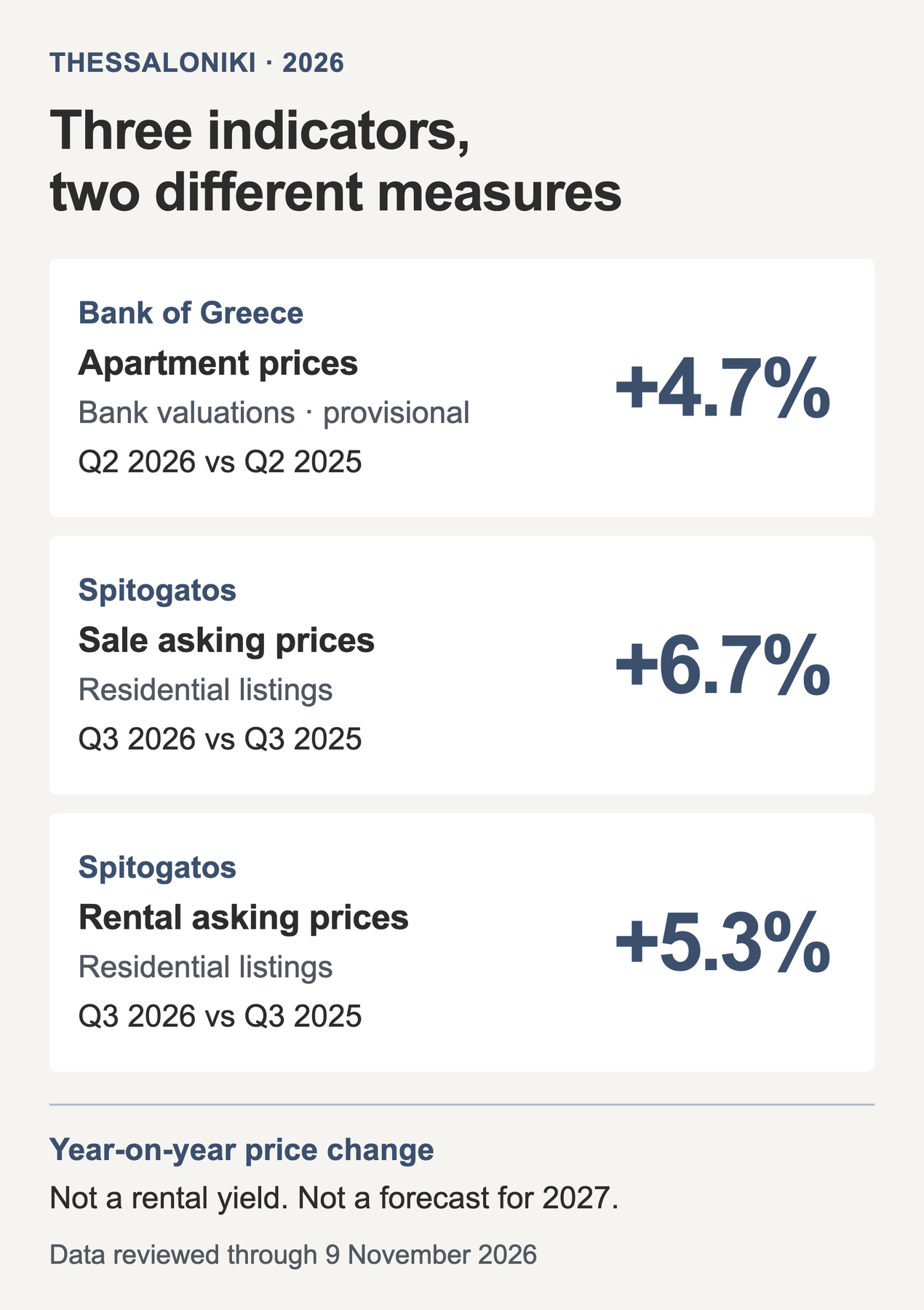
The two sources point to increases in their respective measures. They do not form a single price series. Comparing the bank index directly with the listing figure cannot establish that the market accelerated between quarters, or reveal a typical negotiation discount.
The Bank of Greece figures are nominal: they do not remove inflation. A change in property values also says nothing, by itself, about rental income, ownership expenses or the proceeds available after an eventual sale.
2. Slower growth still means a higher price level
Spitogatos reports that Thessaloniki’s annual asking-price increases in Q3 2025 were 11.0% for sales and 7.7% for rentals. Both annual growth rates were lower in Q3 2026. This is evidence of slower growth within that source’s series, rather than falling advertised prices. Spitogatos’ quarterly comparison.
For a buyer, the useful question is how much of the property’s appeal is already reflected in the price. A renovated apartment may justify a premium over one requiring work, but the premium needs to stand up against comparable properties and a written specification. A general market increase cannot establish its fair value.
The Bank of Greece’s published methodology groups valuations by characteristics including location, age and size, and adjusts for floor. This helps account for differences in the properties being measured. It does not produce a valuation for every address, and bank valuations are not a complete register of agreed transaction prices. Bank of Greece methodology.
For an apartment under consideration, ask what evidence supports the seller’s price: comparable asking prices, documented completed sales or a property-specific valuation. Each answers a different question. If completed-sale evidence is unavailable, keep that uncertainty visible when deciding your offer.
3. Rising asking rents do not establish your future income
An advertised rent shows what an owner is seeking. It does not establish what a tenant agreed to pay, how long the apartment stood empty, or whether payments were collected. Spitogatos itself distinguishes asking prices from the prices at which deals close. SPI definitions and methodology.
The faster growth in sale asking prices than in rental asking prices is a reason to examine the relationship between purchase cost and rent carefully. It does not calculate the yield on an individual apartment: properties advertised for sale and for rent are different samples.
To turn the market figures into a rental assumption, compare the apartment with current long-term listings nearby that have similar characteristics. For an occupied property, examine the lease and payment records separately. This distinguishes the wider asking-price context from income supported by evidence for the apartment itself.
4. Area averages help narrow a search, not rank investments
The geographical detail is useful precisely because Thessaloniki does not have one uniform housing market. Spitogatos’ Q3 2026 report gives these examples within its wider Thessaloniki coverage:
| Area named by Spitogatos | Average sale asking price, €/m² |
|---|---|
| Kalamaria | €3,243 |
| Migdonia | €938 |
Source: Spitogatos, Q3 2026 area figures. These are residential listing aggregates, not matched apartments or completed-sale prices.
The gap does not make the lower-priced area an automatic bargain. The properties, locations and tenant requirements are not interchangeable. Nor should the portal’s wider geographical grouping be assumed to match the Bank of Greece series exactly.
Area averages help decide where to look. The next step is a narrower comparison with similar apartments close to the property. A price below the area average may reflect the building’s condition, the floor or work still required. Treat it as a reason to investigate, rather than a conclusion about value.
5. Turn the market picture into a property decision
Before making an offer, assemble a short evidence file. It should connect the market narrative to the apartment’s price and operating plan.
| Decision | Evidence to request or prepare |
|---|---|
| Is the purchase price justified? | Dated comparable properties, their differences and the basis of any valuation |
| Is the rental assumption credible? | Comparable long-term listings, available lease evidence and a clearly identified tenant group |
| What is the full initial commitment? | Agreed price plus acquisition, professional, renovation and furnishing costs, with inclusions reconciled |
| What could interrupt income? | Technical findings, work schedule, vacancy allowance, maintenance provision and management terms |
| Can the investment be held through a weaker period? | Cash needs during vacancy, financing payments where relevant and an exit timetable that allows for delay |
A ready-to-let property may reduce the work you need to organise, but its price may include a premium. A cheaper property requiring renovation may leave more control over the specification while introducing cost and timing uncertainty. Compare the total commitment and responsibilities in each case.
For planning, test a case with no increase in rent or resale value, alongside a weaker case involving vacancy or an unexpected repair. These are stress tests, not market forecasts. If the purchase only works with rapid appreciation or immediate full occupancy, the available market data do not justify that dependence.
An investor who needs the capital back quickly may find that the purchase timetable, potential selling costs and uncertain exit date do not fit their needs. Deciding to wait, negotiate or reject a property can be a sound result of the analysis.
6. What to refresh before a 2027 purchase
At the point of commitment, update the comparable properties and rental evidence, then read the next available releases from each source separately. Check for revisions to earlier bank-index figures and keep quarterly changes distinct from full-year averages.
Refresh the property’s technical findings, works budget and management proposal as well. Obtain current financing terms if borrowing, and have the relevant professionals confirm the taxes and rules applicable to the transaction and ownership structure. Future announcements should not be treated as rules already in force.
The practical conclusion is to set a price you can defend from property-level evidence and a rental plan you can carry through a less favourable period. The market data provide context; the apartment’s economics determine whether it fits.
Wiser acquires and renovates residential properties in Thessaloniki and supports long-term letting and ongoing management. For a structured next step, explore the Wiser investor guide or speak with the team about a specific apartment, its documented specification and the services included in the proposal.
Frequently asked questions
Which figure should I use when the Bank of Greece and Spitogatos report different growth rates?
Use the Bank of Greece index to understand trends in bank valuations, and Spitogatos to understand advertised prices. Differences can reflect the type of evidence, the properties covered and geographical coverage; the figures in this article also cover different quarters. To assess whether growth is strengthening or slowing, compare observations within the same series using equivalent periods. Do not combine the two sources into one price series.
How can I set an offer when I can only find asking prices, not completed sales?
You can form a provisional offer range, recognising that listings do not establish what buyers actually paid. Compare similar properties nearby and record differences in size, floor, condition and listing date. Seek an independent valuation and an explanation for any premium over the alternatives. Where completed-sale evidence is unavailable, avoid assuming a standard discount from the asking price and reflect that uncertainty in the maximum you are prepared to offer.
Does growth in the city’s asking rents justify increasing my apartment’s income forecast?
Not automatically: a change across the city’s listings does not establish that your apartment can command a higher rent. Check current long-term listings for comparable homes nearby, alongside recent signed leases where available. For an occupied apartment, examine the lease and actual payment records separately. Increase the income assumption only when evidence for the property or close comparables supports it, and retain a planning scenario in which rent does not rise.
Is slower price growth a reason to wait until 2027 before buying?
Not by itself: slower growth does not mean prices have fallen, and it does not establish what will happen in 2027. Waiting can be useful if it allows you to resolve material uncertainty about the apartment’s price, achievable rent or condition. Another index release alone will not determine whether the purchase makes sense. Base the timing on the evidence, the price and your ability to hold the property without relying on appreciation.
If I plan to sell within a few years, what do the market figures leave unanswered?
They do not estimate when your apartment will sell or what proceeds you will receive. A rising city index does not show how long it will take to find a buyer for a particular property. Before buying, review competing homes, available evidence of comparable completed sales, selling costs and your ability to keep holding if a sale is delayed. If you need the money by a fixed date, assess whether that uncertainty fits your plans without appreciation.


